|
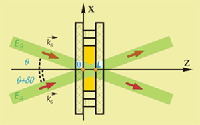
Fig.
1 |
Photosensitive polymeric
materials are of a
great interest now in the fields of holographic recording,
dynamic holography
and
optical data processing.
They are considered to be perspective nonlinear media owing to
their high sensitivity and complicated dynamical properties that
result in variety of multiwave mixing effects observed in
experiments. Large nonlinear susceptibilities of azo-containing
polymers enable processing of optical signals with the
intensities less than 1 mW/cm2. Dynamics of the medium response
in these processes strongly depends on the operating conditions.
However, some peculiarities of the complex behavior of organic
materials in photo-induced processes have not been well studied
yet.
Investigations of
nonlinear properties of azo dye containing polymers and
possibilities of their applications are accomplished actively in
our laboratory. One of the main directions is study of
holographic characteristics of polymer film samples,
optimization of external conditions and recording schedule for
more dense holographic
recording. The other
is concentrated on two-wave mixing phenomena study and their
application to dynamic
holography and
adaptive interferometry.
In our experiments we use
rather thick film samples (about 50 mkm) of
amorphous
and liquid-crysalline
azo dye containing polymers
having different
concentration of azo dye. The polymer films are placed into
heat-insulated cells enabling to control temperature of a
sample. The recording scheme is classical. Object and reference
waves are crossed in the plane of the polymer film and produce
an interference pattern
(Fig. 1).
The excitation light gets into a wing of the azo dye absorption
line and provides effective influence on the medium. The
wavelength of probe (reading out) light is not absorbed by azo
dye and does not affect the polymer. Under acting light the
photosensitive molecules forming the polymer undergo
isomerization that
leads to local change in the
refractive index
and the absorption
coefficient. As a
result, a gain-phase relief is formed in the polymer film that
represents a
gain-phase hologram.
Reading out beam diffracts on the lattice restoring the initial
image. In the case of dynamic holography the wavelength of
reading out light is the same that of recording and the hologram
is stored and erased simultaneously. In such situation phase and
amplitude modulation of the signal beam is transformed due to
the two-wave interaction in nonlinear medium and allows optical
signal processing.
Adaptive interferometry
is a combination of
dynamic holography and
adaptive optics.
Realization of dynamic holography methods using nonlinear
optical media as the beam mixer allow to improve characteristics
of interferometric systems as well as essentially simplify their
design. Along with some applications, adaptive interferometers
can be used for nonlinear materials study.
Experiments show that the
system adapts to the external condition variation. This property
of adaptive interferometer allows suppress low frequency
components while registration of high frequency phase
perturbations.
|
|
PUBLICATIONS:
Simonov A.N., Uraev
D.V., Shibaev V.P., Kostromin
S.G.,
Photoreversible optical data recording in films of amorphous azo
dye-containing polymers,
Quantum Electronics, 32 (2002) 143.
Simonov A.N.,
Larichev A.V., Shibaev V.P.,
Stakhanov A.I., Compensation of Dynamic Phase
Distortions in the Phase Conjugation System
Based on the Film of Azocontaining
Liquid-Crystalline Polymer,
Optics and Spectroscopy, Vol. 92, No. 4, 2002, pp. 536–543.

Simonov A.N., Uraev D.V., Kostromin S.G., Shibaev V.P.,
Stakhanov A.I., Polarization-controlled optical recording in the films of
azocontaining amorphous polimers,
Laser Physics, 2002. V. 12. P.
1294–1299.
Simonov A.N., Andreeva
M.S., Shmalhausen V.I., Shibaev
V.P.,
Dynamics of two-wave interaction in azocontaining photosensitive
liquid crystalline polymer,
Quantum Electronics, 31 (2001) 599
Andreeva M.S., Shmalhausen
V.I., Simonov A.N.,
Two-wave coupling in azo-containing photosensitive polymers with
liquid crystal properties,
SPIE proceedings, 4750 (2001) 247
Simonov A.N., Larichev
A.V., Shibaev V.P., Stakhanov
A.I.,
High-quality correction of wavefront distortions using low-power
phase conjugation in azo dye containing LC polymer,
Optics Comm., 197 (2001) 175. |