|
Project Title:
Adaptive Optics, Imager
and Analytic Software for Medical Retinal Imaging
Project Number:
SfP 97-4292
Project Co-Directors:
Partner Country Project
Director: Dr. Andrey Larichev, Ph.D., Institute on Laser and
Information Technologies (ILIT RAS) Svyatoozerskaya Str. 1,
Shatura, 140700 Moscow Region, Russia
NATO Country Project
Director: Dr. Leonard John Otten III, Ph.D., Kestrel
Corporation, Vice President, 6624 Gulton Court, NE, Albuquerque,
New Mexico, 87109, USA
In the framework of the
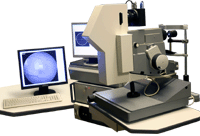
Project a novel
multispectral retinal imager
with
adaptive compensation of eye
aberrations was
created. The overall objective of this Program is to demonstrate
that a combination of low-bandwidth
adaptive optics
and an optimized
deconvolution
technique can be used to increase
retinal multispectral imaging
resolution and that
the resulting instrument will improve the level of
ophthalmological healthcare.
To meet this objective we
propose to complete the following tasks:
●
To develop the theory of
retinal image formation under the anisoplanatic conditions
including determining the optimal phase correction/measurements
algorithms.
●
To design and manufacture a
specialized Shack-Hartman sensor to fit a multispectral fundus
camera optical system.
●
To design and manufacture an
appropriate reference source for dynamically maintaining retinal
focus. This "focus on demand" allows the best viewing of the
area of interest on the retina under anisoplanatic conditions.
●
To modify an existing
flexible mirror design to achieve the best performance in the
correction of low-order human eye aberrations and adapt it to
the fundus imager optical design.
●
To adapt the deconvolution
algorithm for optimal functioning when coupled to the adaptive
optics low-order corrector. To optimize the related software for
PC computers.
●
To perform laboratory tests
of the complete breadboard system against known degradations
using a multispectral fundus imaging system. To collect
quantitative optical performance data using the as-built
hardware.
●
To conduct limited clinical
demonstrations in Russia and the United States.
All these tasks have been
completed. Two units of the
retinal imager with adaptive
compensation of eye aberrations
have been built. The developed fundus imager has been
patented
in United States (#US 6331059 B1,
December 18, 2001)
|